At a glance
- Em dashes appeared in style guides and published writing long before public generative-AI tools.
- Word processors, editors, house styles, dictation tools, and authors themselves can all put the mark on the page.
- A detector examines many patterns and still cannot reconstruct a writing process with certainty. One punctuation mark does less.
- If the concern is authorship, disclosure, copying, or quality, examine evidence that actually answers that question.
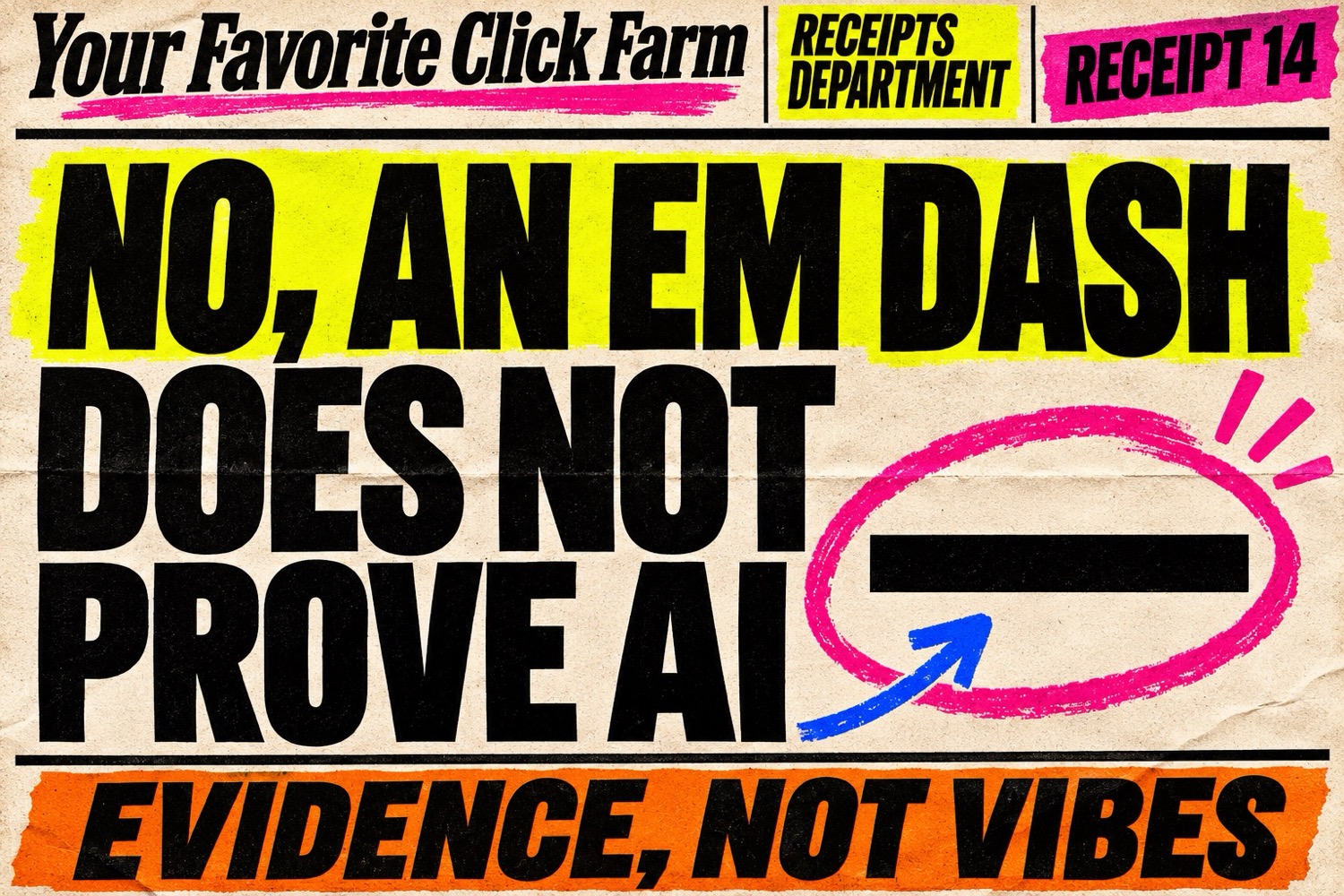
Somewhere along the way, the em dash became evidence.
People take a screenshot, circle the long dash, and announce that the writing came from AI. The same thing happens with certain words, tidy headings, or sentences that sound a little too polished. Apparently, we can now determine how an entire piece was written because someone used punctuation correctly.
That would be very convenient if the em dash belonged to ChatGPT.
It does not.
The Associated Press Stylebook addressed this exact question last year. No, an em dash does not mean something was written by AI. AP has been using the mark for years and has rules for when its journalists should use it. Microsoft has rules for it. Google has rules for it. The U.S. Government Publishing Office had rules for it before the public had access to ChatGPT.
AI did not invent the em dash. It learned the mark from writing people had already produced.
The dash was already here
An em dash is useful when a writer wants to interrupt a thought, add an aside, or make a turn that needs more weight than a comma can carry. Some writers love them. Some editors remove half of them. Different publishers cannot even agree on whether spaces belong around them.
AP uses spaces. Microsoft and Google generally do not. Nobody has accused the style guides of secretly sharing a chatbot account.
The National Center for Education Statistics explained how to create an em dash in Microsoft Word in a style guide published in 2004. The U.S. Government Publishing Office included the mark in its 2016 manual. Both documents predate the current generative-AI panic by quite a bit.
Older typing systems often represented a long dash with two hyphens because the proper character was difficult to produce. Word processors made the actual mark easier to insert, and some programs automatically convert paired hyphens into one. That means software may be responsible for the shape of the punctuation even when a person wrote every word around it.
This is ordinary editing and formatting. It is not a confession hidden in the typography.
So why do people call it an AI tell?
Because AI writing does develop habits. Anyone who has spent enough time with generated prose has seen them. A model may favor certain transitions, sentence shapes, headings, or punctuation. Some outputs are so generic that you can practically hear the prompt rattling around behind them.
Noticing that is fine. I notice it too.
The problem comes when a recognizable habit is treated as exclusive to AI. It usually is not. Human writing was part of the material these systems learned from in the first place. The words, punctuation, and sentence structures did not originate inside the model.
An em dash may appear often in generated text. It also appears in novels, journalism, government documents, technical manuals, emails, and the work of people who have been using it since long before anybody could ask a chatbot to write a launch post.
That makes it a weak clue on its own. It may be a reason to look more closely if the origin of the writing genuinely matters. It is not enough to declare that the question has been answered.
There is a fairly important difference between “this reminds me of AI writing” and “this person used AI.” The first is an impression. The second is a factual claim about what somebody did.
The impression might be right. It still needs evidence before it becomes the claim.
The finished page does not show the whole process
Even when software did affect the punctuation, that tells us very little about who created the work.
An author might dictate a chapter and let the program add punctuation. A grammar tool might suggest replacing a pair of commas. A copy editor might add a dash because it fits the publisher’s house style. Formatting software might change two hyphens into the proper character when the manuscript becomes an ebook.
The author could also have typed the dash. It is right there on a Mac keyboard. Windows has shortcuts for it. Google publishes instructions for entering it on several operating systems. We are not dealing with a symbol that can only be obtained through a secret meeting with a language model.
The same problem applies to other supposed tells. Clean headings can come from a human who outlines. Repeated sentence structures can come from a writer’s habits. Formal language may reflect education, genre, translation, or an editor. A suspiciously polished paragraph may have been revised twelve times by the person who wrote it.
It may also have been generated. The point is that the paragraph alone does not always tell us which explanation is true.
Research on AI detection keeps running into this problem. Detection systems examine patterns in the finished text and classify what they see. They are not watching the document being made. A 2026 review in AI and Ethics explains that the overlap between human and machine writing creates unavoidable uncertainty, especially when text has been edited, translated, or moved into a different genre from the material used to test the detector.
That is a full detection system working across many features. Circling one punctuation mark is not a more advanced method.
If the writing is bad, say what is bad about it
Sometimes “this sounds like AI” is really a review of the prose. The writing may be repetitive, vague, overstructured, or full of transitions that do not sound like anything a person would say out loud.
Then say that.
Quote the repetition. Point to the paragraph that says nothing. Explain why the dialogue feels stiff or why the argument never reaches a point. Those are useful criticisms because the writer can see the problem and fix it.
An em dash is not the problem with a bad paragraph. Removing it will not give the paragraph a personality.
This matters because the accusation has consequences beyond the quality of the work. “I do not like this writing” is an opinion. “This author generated the book and lied about it” is an accusation about conduct. We should not slide from one to the other because explaining why a paragraph fails takes more effort.
And if the writing is good, that is not proof either. People are still capable of writing well. I cannot believe that needs to be said, but here we are.
Look for evidence that answers the question
If the question is whether a platform disclosure rule was broken, read the rule and find out what the tool actually contributed. A platform may distinguish between generated material, editing help, brainstorming, dictation, and other assistance. The punctuation cannot make that distinction for us.
If the question is authorship, look for material connected to the writing process: drafts, revision history, dictation files, editorial notes, or a consistent account of how the work was made. Those records are not perfect, but at least they address the question being asked.
If someone is alleging plagiarism or copyright infringement, identify the source work and the expression that was copied. Two books containing the same punctuation mark is not a comparison of protected expression. It is two books containing punctuation.
None of this means people must ignore obvious warning signs. A sentence left in the manuscript that responds to a prompt is meaningful evidence. A fabricated citation can be checked. A copied passage can be compared with its source. A disclosure can be measured against the rule that required it.
Those are actual things. They give us something to investigate.
The em dash gives us a pause in a sentence.
Use it. Hate it. Remove every one from your own writing if you want. Just stop asking punctuation to testify about who wrote the book.
Sources and documents
These links support the factual claims in this explainer. Interpretive conclusions are identified in the article and should be read with the underlying record.
- Associated Press Stylebook: The Em Dash—A Valid Punctuation Mark or AI Tell?
- Microsoft Style Guide: Em Dashes, En Dashes, Hyphens, and Minus Signs
- Google Developer Documentation Style Guide: Dashes
- National Center for Education Statistics: NCES Style Guide
- U.S. Government Publishing Office: Style Manual
- AI and Ethics: The Pitfalls of AI Detection in Academic Writing